Selected publications
Alignment of the ATLAS Inner Detector in Run 2
Search for displaced leptons in \( \sqrt{s} = 13 \) TeV \(pp\) collisions with the ATLAS detector
Emulating the impact of additional proton-proton interactions in the ATLAS simulation by pre-sampling sets of inelastic Monte Carlo events
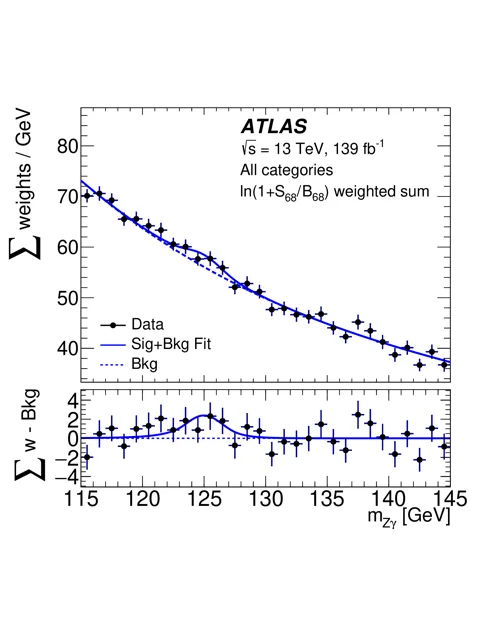
A search for the \(Z\gamma\) decay mode of the Higgs boson in \(pp\) collisions at \(\sqrt{s} = 13\) TeV with the ATLAS detector
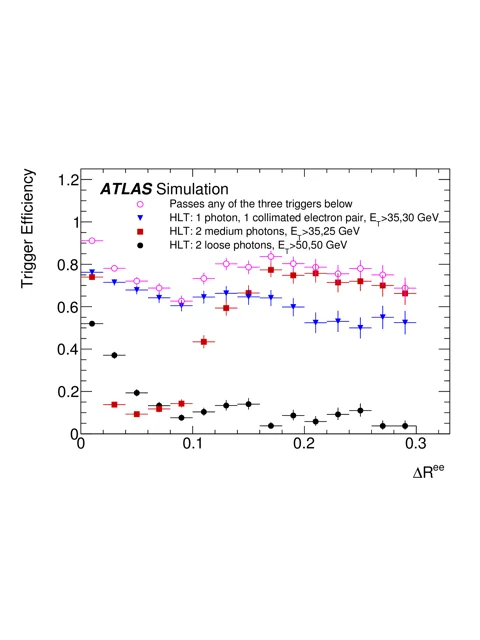
Performance of electron and photon triggers in ATLAS during LHC Run 2
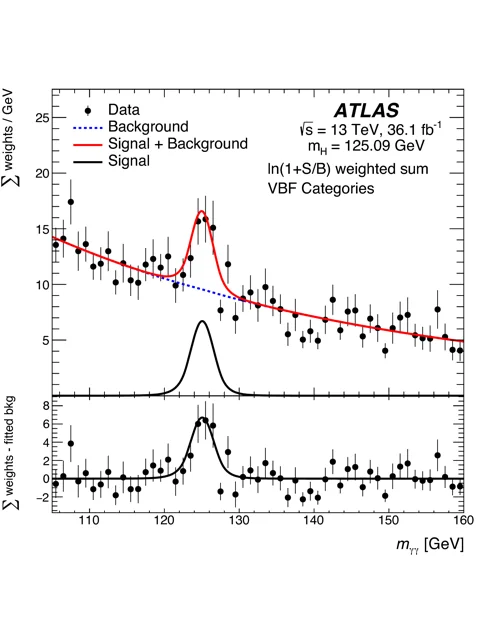
Measurements of Higgs boson properties in the diphoton decay channel with 36 fb\(^{−1}\) of pp collision data at \(\sqrt{s} \)=13 TeV with the ATLAS detector
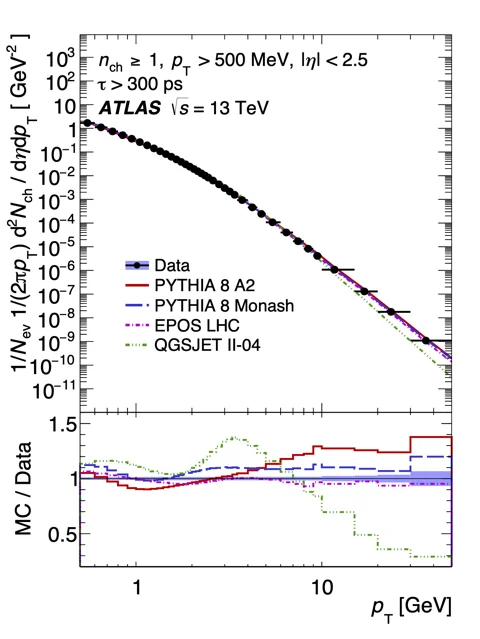
Charged-particle distributions in \(\sqrt{s} \)=13 TeV pp interactions measured with the ATLAS detector at the LHC
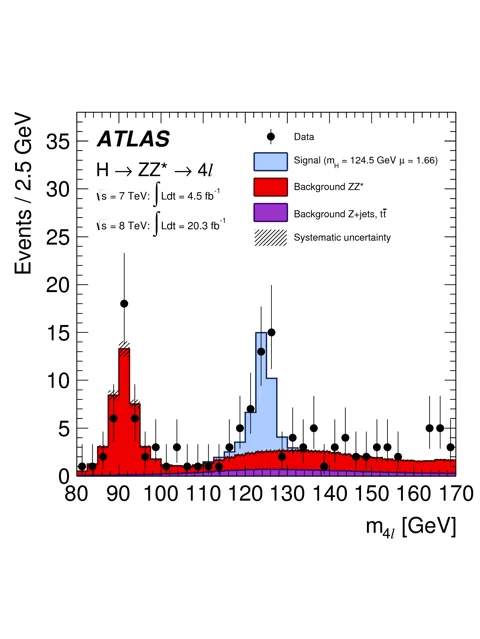
Measurement of the Higgs boson mass from the \(H\to\gamma\gamma\) and \(H\to ZZ^{*}\to 4\ell\) channels with the ATLAS detector using 25 fb\(^{−1}\) of pp collision data
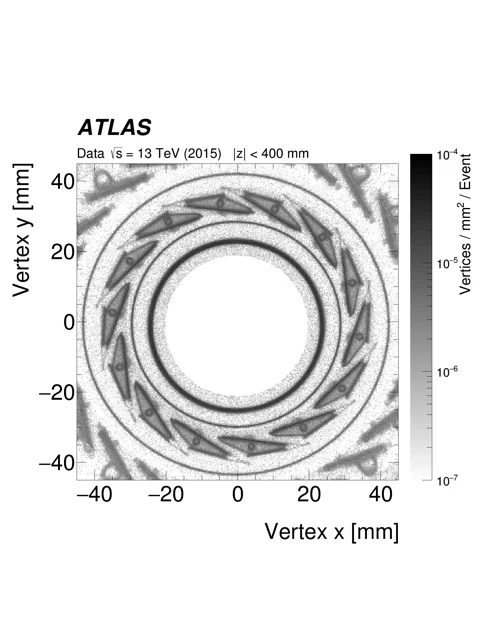
Study of the material of the ATLAS inner detector for Run 2 of the LHC
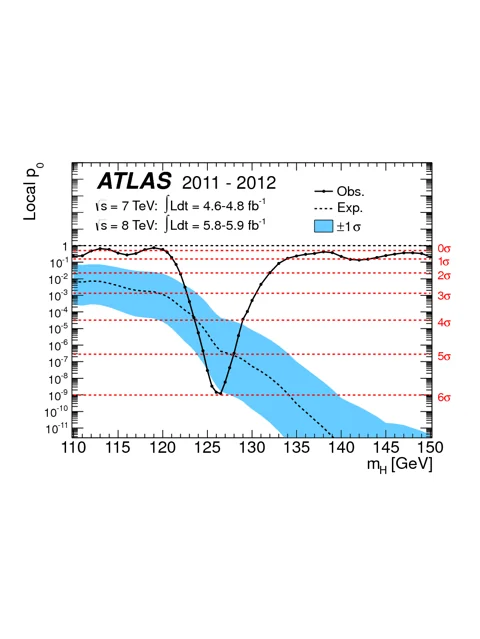
Observation of a new particle in the search for the Standard Model Higgs boson with the ATLAS detector at the LHC
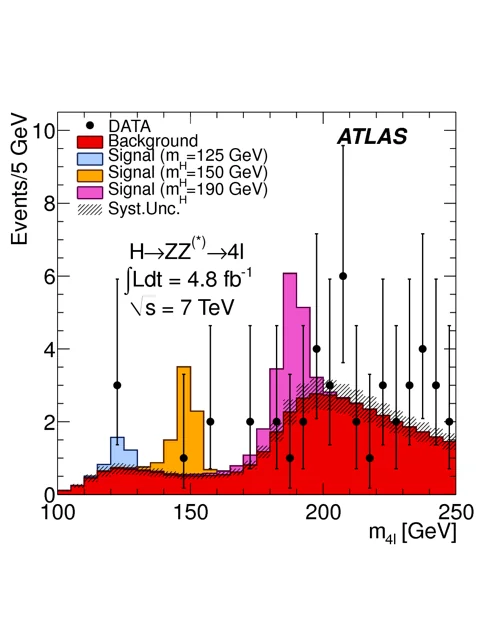
Search for the Standard Model Higgs boson in the decay channel H->ZZ(*)->4l with 4.8 fb-1 of pp collision data at sqrt(s) = 7 TeV with ATLAS
Performance of the ATLAS Track Reconstruction Algorithms in Dense Environments in LHC Run 2
Electron reconstruction and identification efficiency measurements with the ATLAS detector using the 2012 LHC proton--proton collision data
Alignment of the ATLAS Inner Detector and its Performance in 2012,
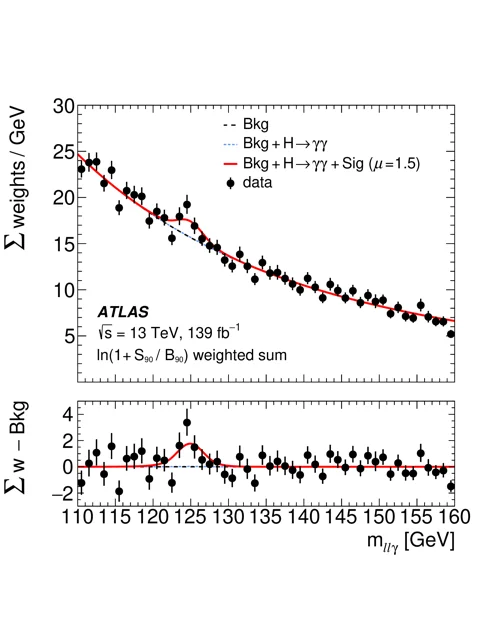
Evidence for Higgs boson decays to a low-mass dilepton system and a photon in \(pp\) collisions at \(\sqrt{s}=13\) TeV with the ATLAS detector
Phys. Lett. B 819 (2021) 136412
What I did
Initiated, designed and led the first analysis of this type in ATLAS. Designing a bespoke particle identification for highly collimated electrons. Investigated machine learning methods for generating simulated events.
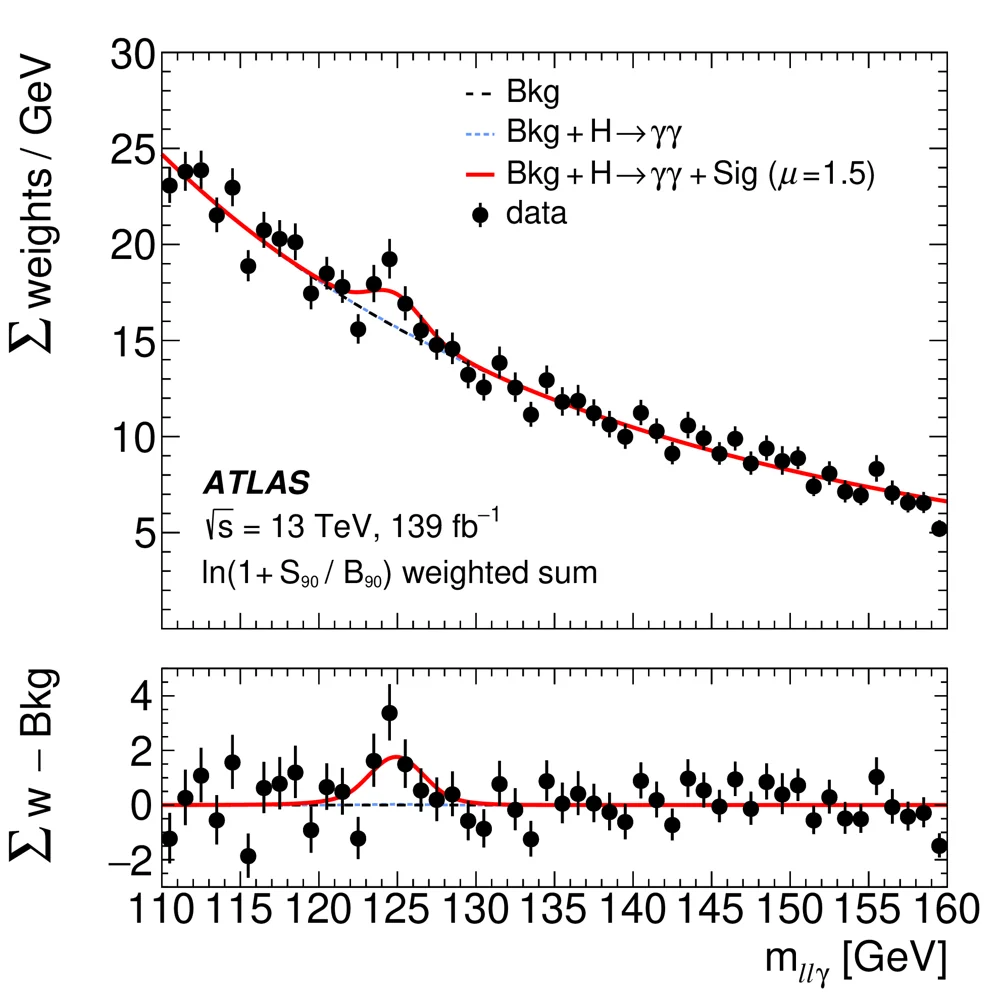
Abstract
A search for the Higgs boson decaying into a photon and a pair of electrons or muons with an invariant mass \(m_{\ell\ell} < 30 \) GeV is presented. The analysis is performed using 139 fb\(^{-1}\) of proton-proton collision data, produced by the LHC at a centre-of-mass energy of 13 TeV and collected by the ATLAS experiment. Evidence for the \(H\rightarrow \ell \ell \gamma\) process is found with a significance of 3.2\(\sigma\) over the background-only hypothesis, compared to an expected significance of 2.1\(\sigma\). The best-fit value of the signal strength parameter, defined as the ratio of the observed signal yield to the one expected in the Standard Model, is \(\mu\) = 1.5 \(\pm\) 0.5. The Higgs boson production cross-section times the \(H\rightarrow\ell\ell\gamma\) branching ratio for m\(_{\ell\ell} < 30\) GeV is determined to be \(8.7^{+2.8}_{-2.7}\) fb.
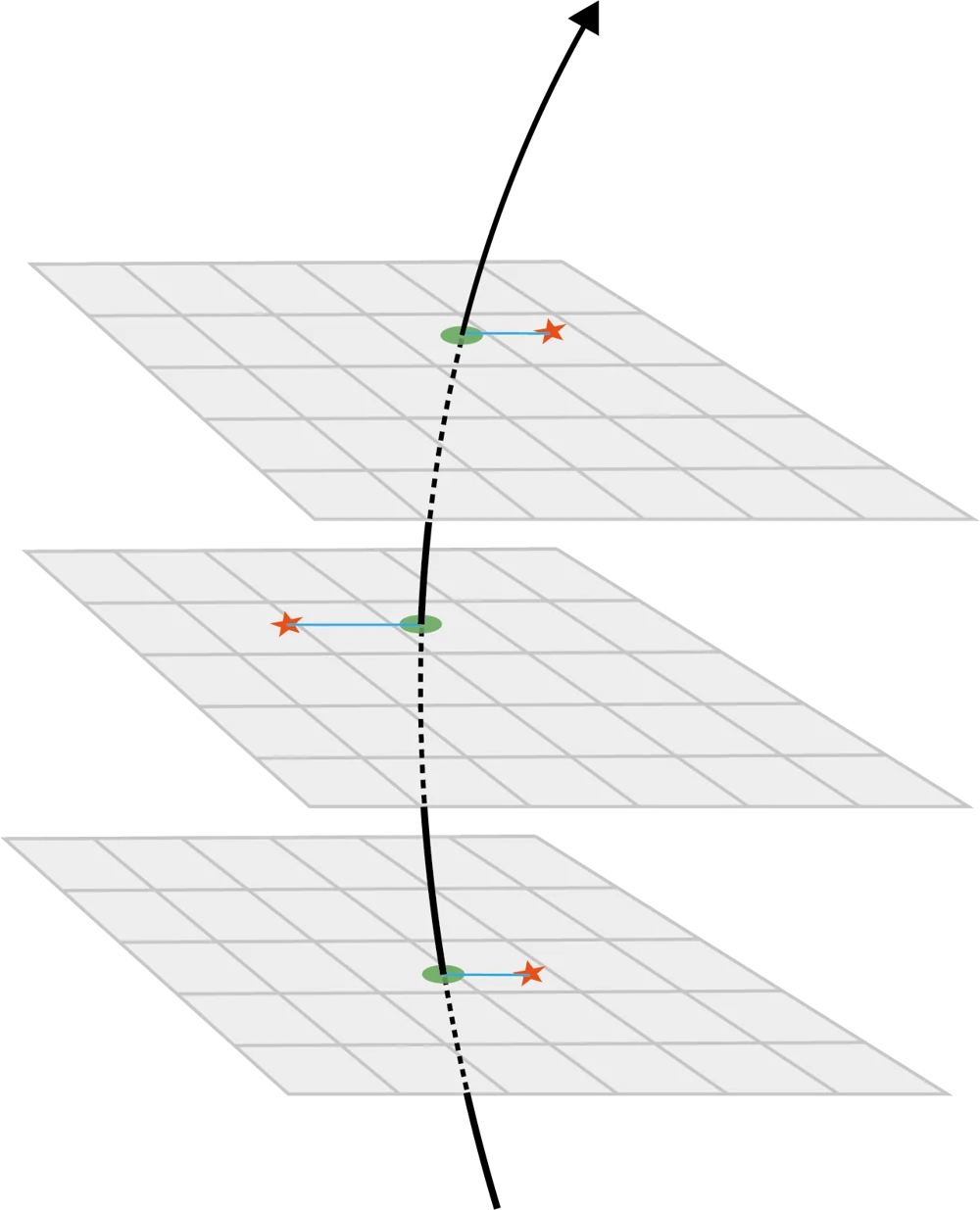
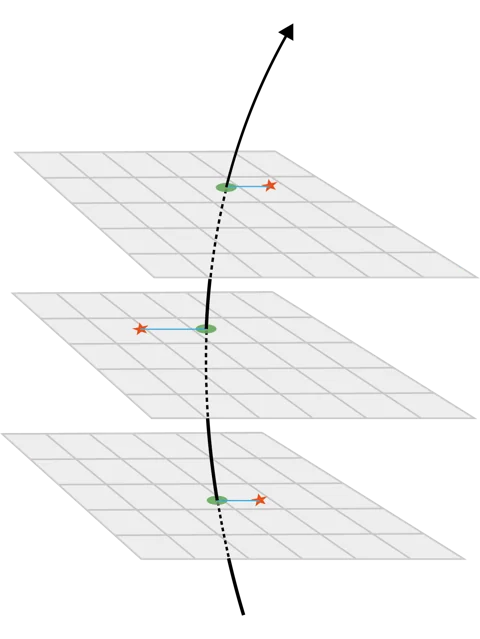
Alignment of the ATLAS Inner Detector in Run 2
Eur. Phys. J. C 80 (2020) 1194
What I did
I was one of the principal architects of the alignment procedure and software in ATLAS this paper documents the performance and strategy during Run 2 of the LHC.
Abstract
The performance of the ATLAS Inner Detector alignment has been studied using \(pp\) collision data at \(\sqrt{s} = 13\) TeV collected by the ATLAS experiment during Run 2 (2015 to 2018) of the Large Hadron Collider (LHC). The goal of the detector alignment is to determine the detector geometry as accurately as possible and correct for time-dependent movements. The Inner Detector alignment is based on the minimization of track-hit residuals in a sequence of hierarchical levels, from global mechanical assembly structures to local sensors. Subsequent levels have increasing numbers of degrees of freedom; in total there are almost 750000. The alignment determines detector geometry on both short and long timescales, where short timescales describe movements within an LHC fill. The performance and possible track parameter biases originating from systematic detector deformations are evaluated. Momentum biases are studied using resonances decaying to muons or to electrons. The residual sagitta bias and momentum scale bias after alignment are reduced to less than \(\sim 0.1\) TeV\(^{-1}\) and 0.9\(\times10^{-3}\), respectively. Impact parameter biases are also evaluated using tracks within jets.
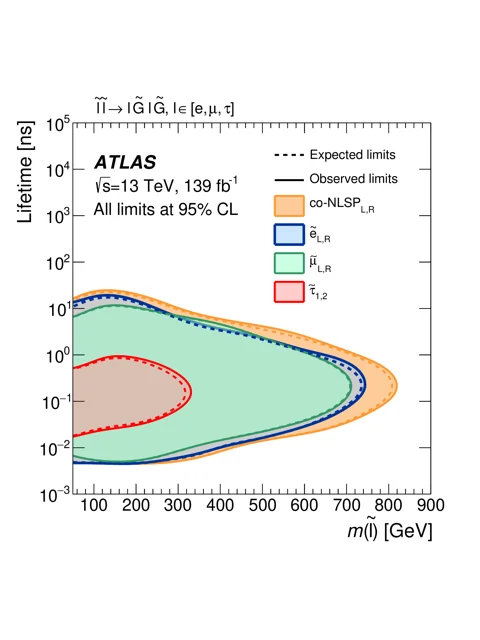
Search for displaced leptons in \( \sqrt{s} = 13 \) TeV \(pp\) collisions with the ATLAS detector
Phys. Rev. Lett. 127 (2021) 051802
What I did
I developed the reconstruction for displaced electrons and measured the efficiency of said reconstruction with the ATLAS detector
Abstract
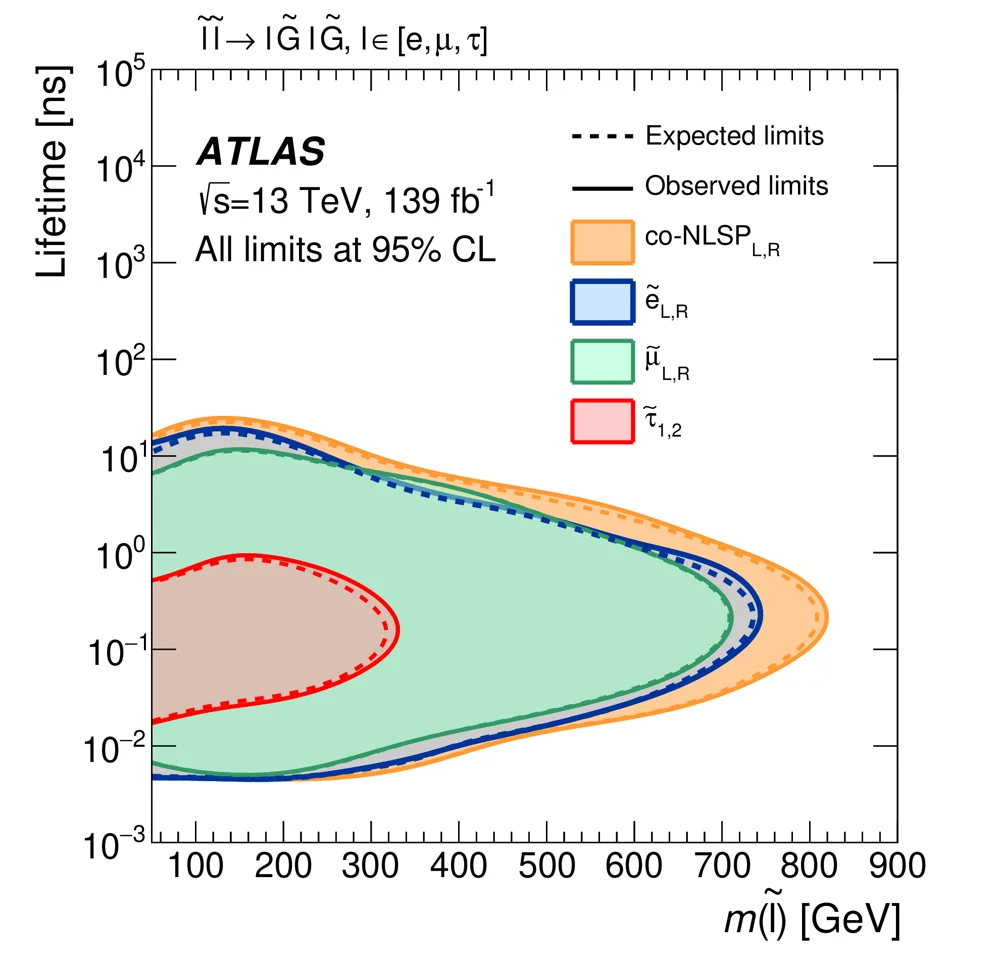
A search for charged leptons with large impact parameters using 139 \( fb^{−1} \) \( \sqrt{s} = 13 \) TeV \(pp\) collision data from the ATLAS detector at the LHC is presented, addressing a long-standing gap in coverage of possible new physics signatures. Results are consistent with the background prediction. This search provides unique sensitivity to long-lived scalar supersymmetric lepton-partners (sleptons). For lifetimes of 0.1 ns, selectron, smuon and stau masses up to 720 GeV, 680 GeV, and 340 GeV are respectively excluded at 95% confidence level, drastically improving on the previous best limits from LEP.
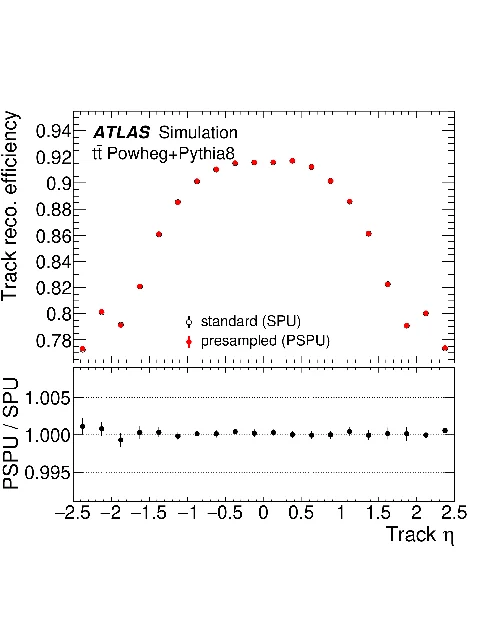
Emulating the impact of additional proton-proton interactions in the ATLAS simulation by pre-sampling sets of inelastic Monte Carlo events
Comput Softw Big Sci 6, 3 (2022)
What I did
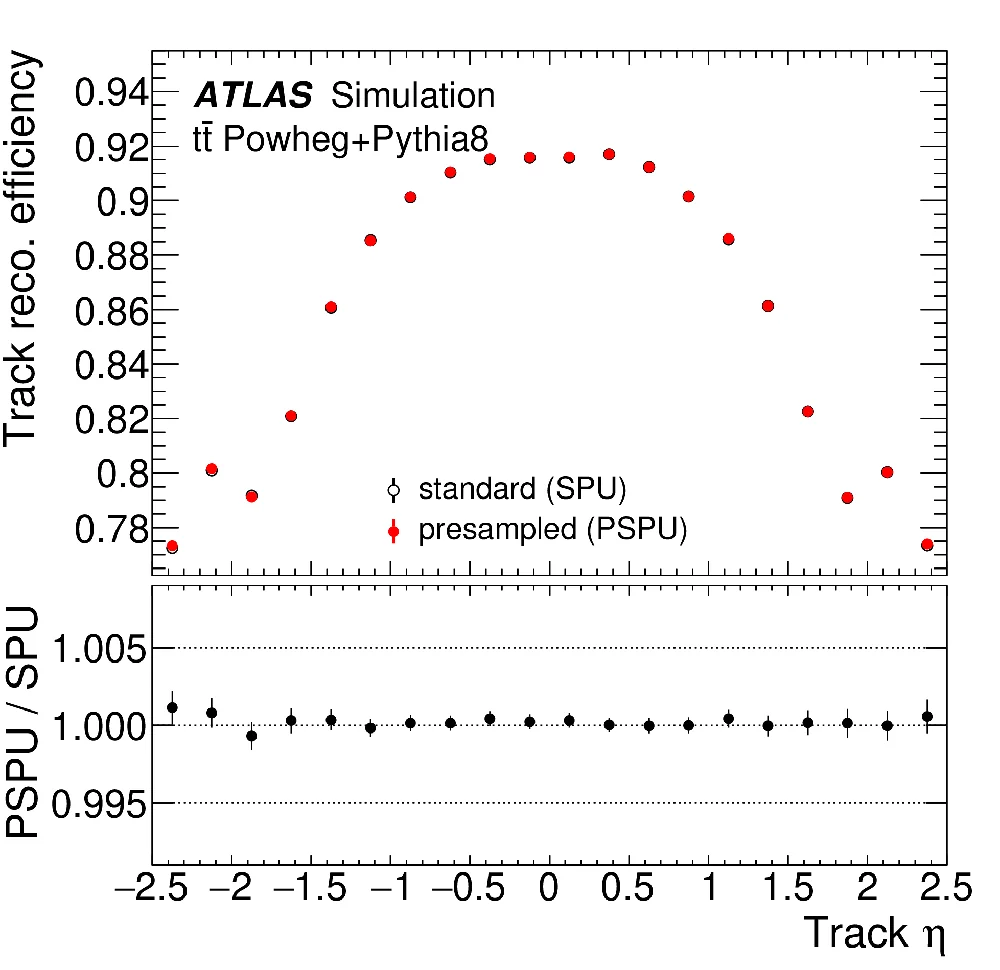
This paper documents a more CPU friendly method for including pileup in simulated proton collisions. I implemented and validated the performance of the ATLAS tracking detectors using this method.
Abstract
The accurate simulation of additional interactions at the ATLAS experiment for the analysis of proton-proton collisions delivered by the Large Hadron Collider presents a significant challenge to the computing resources. During the LHC Run (2015-2018) there were up to 70 inelastic interactions per bunch crossing, which need to be accounted for in Monte Carlo (MC) production. In this document, a new method to account for these additional interactions in the simulation chain is described. Instead of sampling the inelastic interactions and adding their energy deposits to a hard-scatter interaction one-by-one, the inelastic interactions are presampled, independent of the hard scatter, and stored as combined events. Consequently, for each hard-scatter interaction only one such presampled event needs to be added as part of the simulation chain. For the Run 2 simulation chain, with an average of 35 interactions per bunch crossing, this new method provides a substantial reduction in MC production CPU needs of around 20%, while reproducing the properties of the reconstructed quantities relevant for physics analyses with good accuracy.
A search for the \(Z\gamma\) decay mode of the Higgs boson in \(pp\) collisions at \(\sqrt{s} = 13\) TeV with the ATLAS detector
Phys. Lett. B 809 (2020) 135754
What I did
I served as primary contact and editor for this paper, and provided input for the trigger section and object selection for this rare decay of the Higgs boson.
Abstract
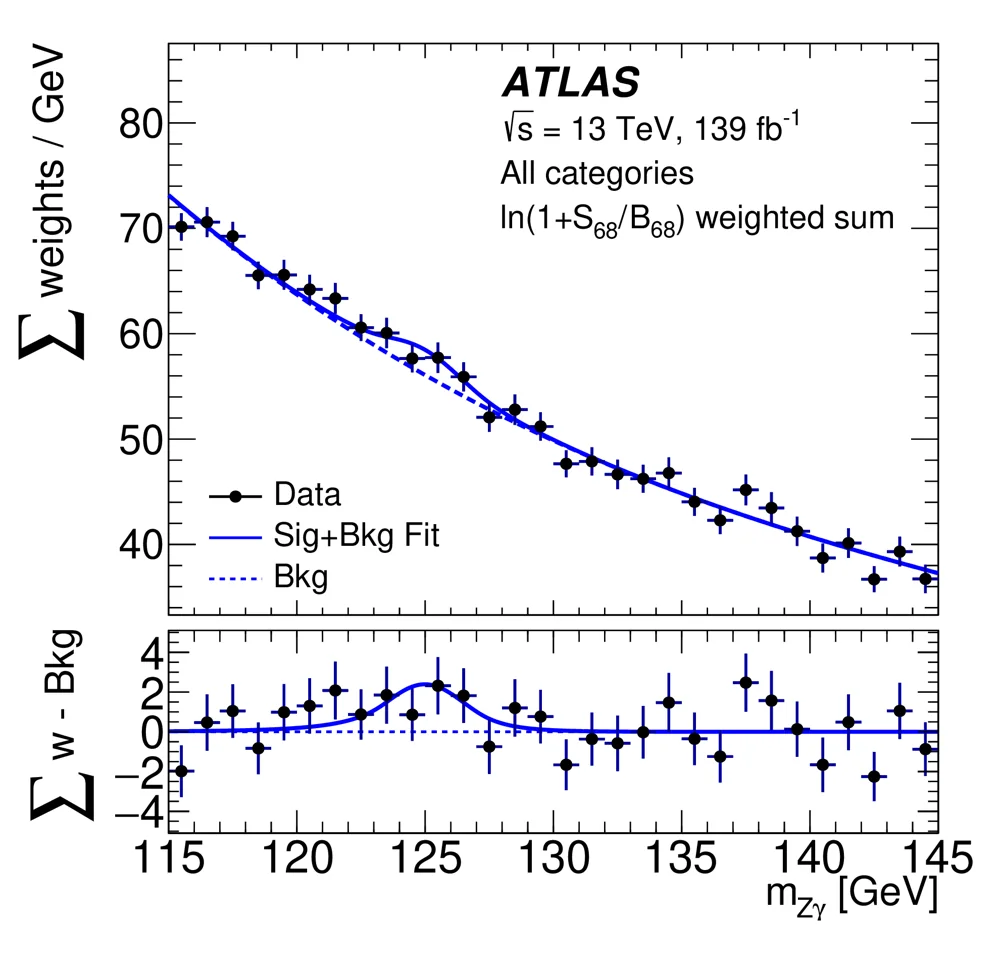
A search for the \( Z\gamma \) decay of the Higgs boson, with \(Z\) boson decays into pairs of electrons or muons is presented. The analysis uses proton--proton collision data at \(\sqrt{s} \) = 13~TeV corresponding to an integrated luminosity of 139~fb \(^{-1} \) recorded by the ATLAS detector at the Large Hadron Collider. The observed data are consistent with the expected background with a \(p\)-value of 1.3\%. An upper limit at 95\% confidence level on the production cross-section times the branching ratio for \(pp\to H\to Z\gamma \) is set at 3.6~times the Standard Model prediction while 2.6~times is expected in the presence of the Standard Model Higgs boson. The best-fit value for the signal yield normalised to the Standard Model prediction is \(2.0^{+1.0}_{-0.9} \) where the statistical component of the uncertainty is dominant.
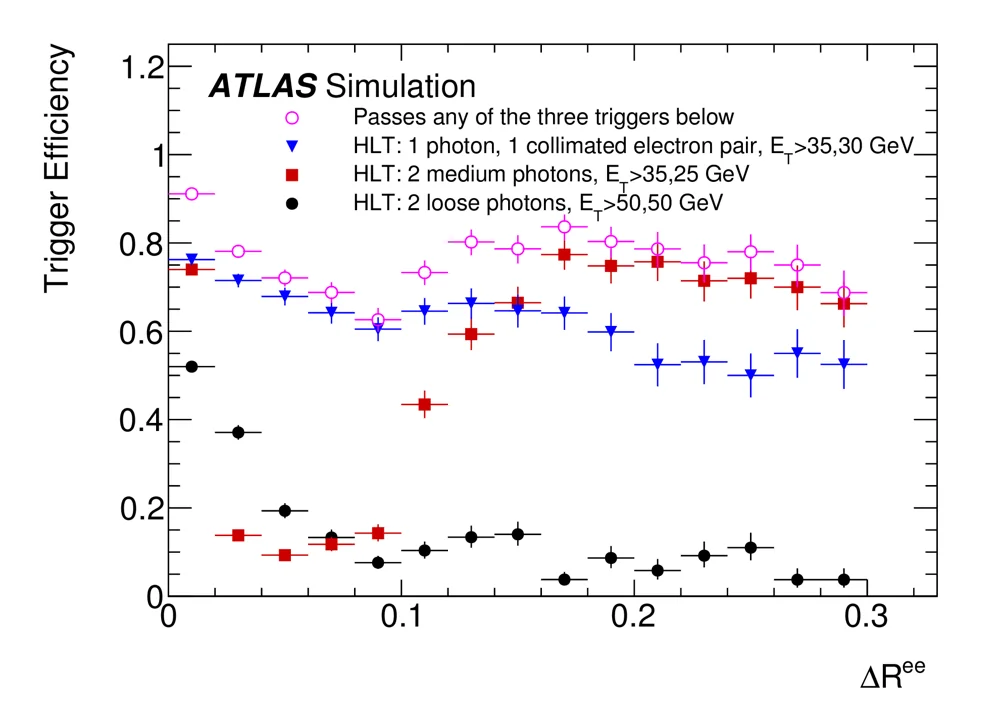
Performance of electron and photon triggers in ATLAS during LHC Run 2
What I did
Documents the performance of the electron and photon trigger for the second Run 2. I developed a bespoke trigger for the Dalitz decay of the Higgs boson which is documented in this paper.
Abstract
Electron and photon triggers covering transverse energies from 5 GeV to several TeV are essential for the ATLAS experiment to record signals for a wide variety of physics: from Standard Model processes to searches for new phenomena in both proton-proton and heavy-ion collisions. To cope with a fourfold increase of peak LHC luminosity from 2015 to 2018 (Run 2), to \( 2.1\times 10^{34}cm^{−2}s^{−1}\), and a similar increase in the number of interactions per beam-crossing to about 60, trigger algorithms and selections were optimised to control the rates while retaining a high efficiency for physics analyses. For proton-proton collisions, the single-electron trigger efficiency relative to a single-electron offline selection is at least 75% for an offline electron of 31 GeV, and rises to 96% at 60 GeV; the trigger efficiency of a 25 GeV leg of the primary diphoton trigger relative to a tight offline photon selection is more than 96% for an offline photon of 30 GeV. For heavy-ion collisions, the primary electron and photon trigger efficiencies relative to the corresponding standard offline selections are at least 84% and 95%, respectively, at 5 GeV above the corresponding trigger threshold.
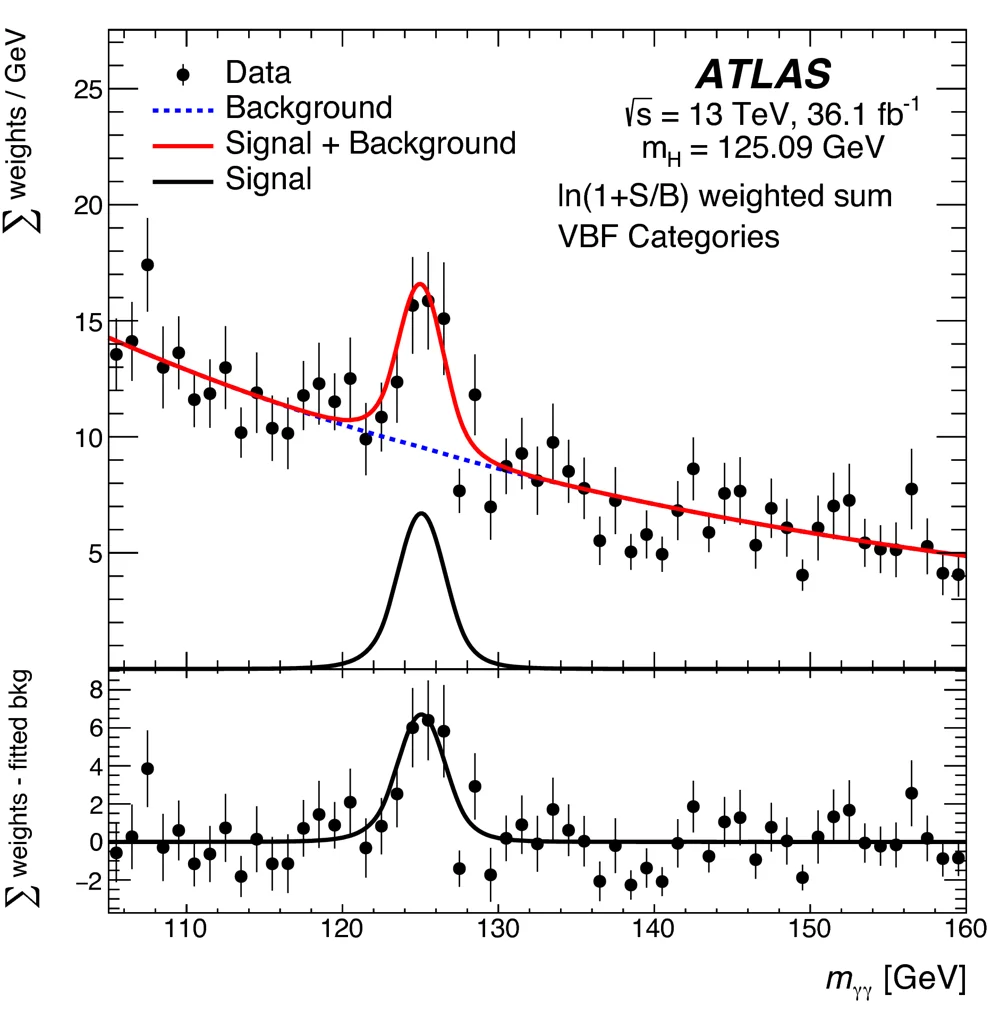
Measurements of Higgs boson properties in the diphoton decay channel with 36 fb\(^{−1}\) of pp collision data at \(\sqrt{s} \)=13 TeV with the ATLAS detector
What I did
Combination of Higgs coupling measurements to vector bosons with the partial Run-2 data-set. I was a primary analyzer in the \(Z\gamma\) input channel.
Abstract
Properties of the Higgs boson are measured in the two-photon final state using 36.1 fb\(^{−1}\) of proton-proton collision data recorded at \(\sqrt{s} \)=13 TeV by the ATLAS experiment at the Large Hadron Collider. Cross-section measurements for the production of a Higgs boson through gluon-gluon fusion, vector-boson fusion, and in association with a vector bosonor a top-quark pair are reported. The signal strength, defined as the ratio of the observed to the expected signal yield, is measured for each of these production processes as well as inclusively. The global signal strength measurement of 0.99±0.14 improves on the precision of the ATLAS measurement at \(\sqrt{s} \)=7 and 8 TeV by a factor of two. Measurements of gluon-gluon fusion and vector-boson fusion productions yield signal strengths compatible with the Standard Model prediction. Measurements of simplified template cross sections, designed to quantify the different Higgs boson production processes in specific regions of phase space, are reported. The cross section for the production of the Higgs boson decaying to two isolated photons in a fiducial region closely matching the experimental selection of the photons is measured to be 55±10 fb, which is in good agreement with the Standard Model prediction of 64±2 fb. Furthermore, cross sections in fiducial regions enriched in Higgs boson production in vector-boson fusion or in association with large missing transverse momentum, leptons or top-quark pairs are reported. Differential and double-differential measurements are performed for several variables related to the diphoton kinematics as well as the kinematics and multiplicity of the jets produced in association with a Higgs boson. No significant deviations from a wide array of Standard Model predictions are observed.
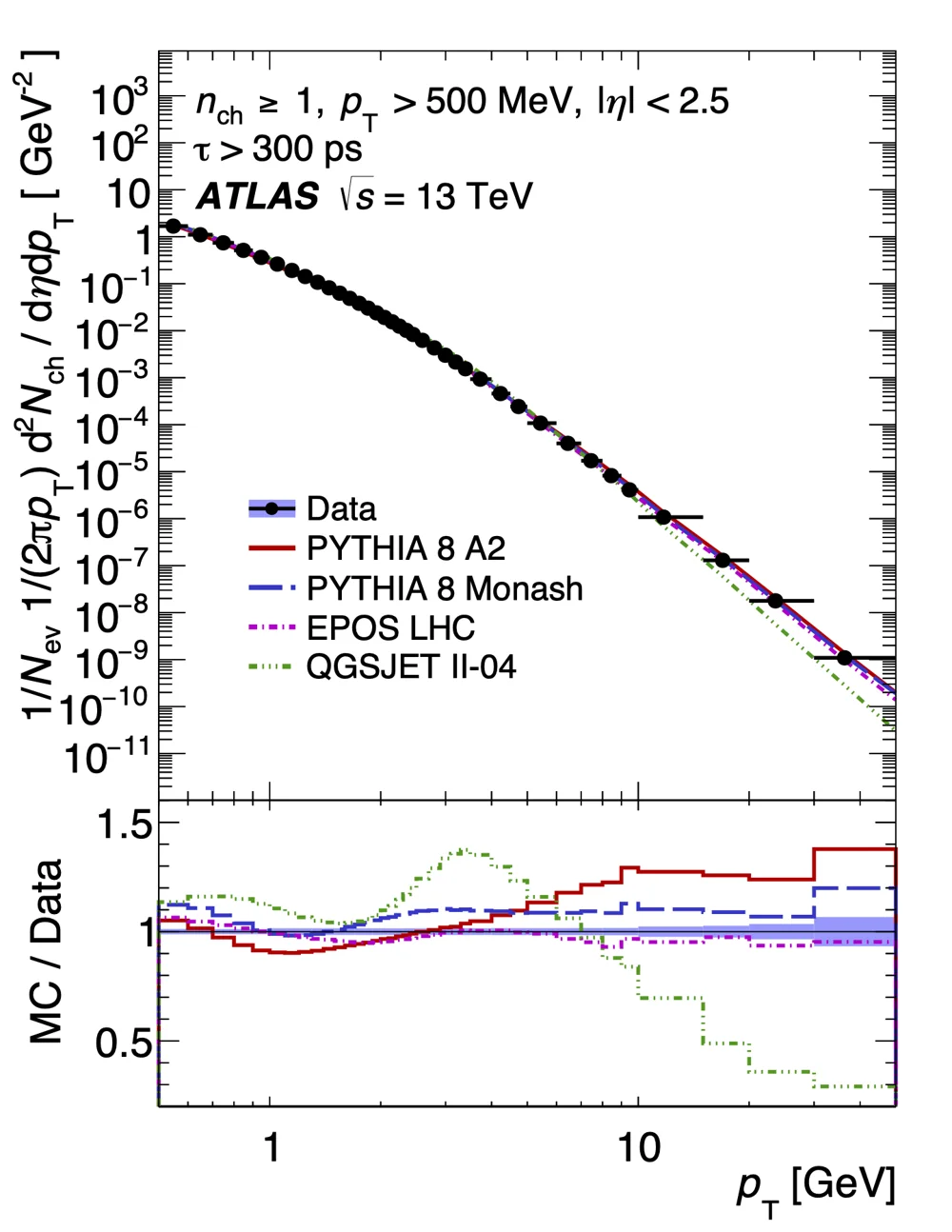
Charged-particle distributions in \(\sqrt{s} \)=13 TeV pp interactions measured with the ATLAS detector at the LHC
What I did
Editor and lead analyst on the first measurement of charged particle multiplicities in \(\sqrt{s} \)=13 TeV pp collisions at ATLAS. A key measurement for the validation of the track reconstruction performance of ATLAS and the modelling of pileup for all subsequent measurements in ATLAS.
Abstract
Charged-particle distributions are measured in proton-proton collisions at a centre-of-mass energy of 13 TeV, using a data sample of nearly 9 million events, corresponding to an integrated luminosity of 170 μb\(^{−1}\), recorded by the ATLAS detector during a special Large Hadron Collider fill. The charged-particle multiplicity, its dependence on transverse momentum and pseudorapidity and the dependence of the mean transverse momentum on the charged-particle multiplicity are presented. The measurements are performed with charged particles with transverse momentum greater than 500 MeV and absolute pseudorapidity less than 2.5, in events with at least one charged particle satisfying these kinematic requirements. Additional measurements in a reduced phase space with absolute pseudorapidity less than 0.8 are also presented, in order to compare with other experiments. The results are corrected for detector effects, presented as particle-level distributions and are compared to the predictions of various Monte Carlo event generators.
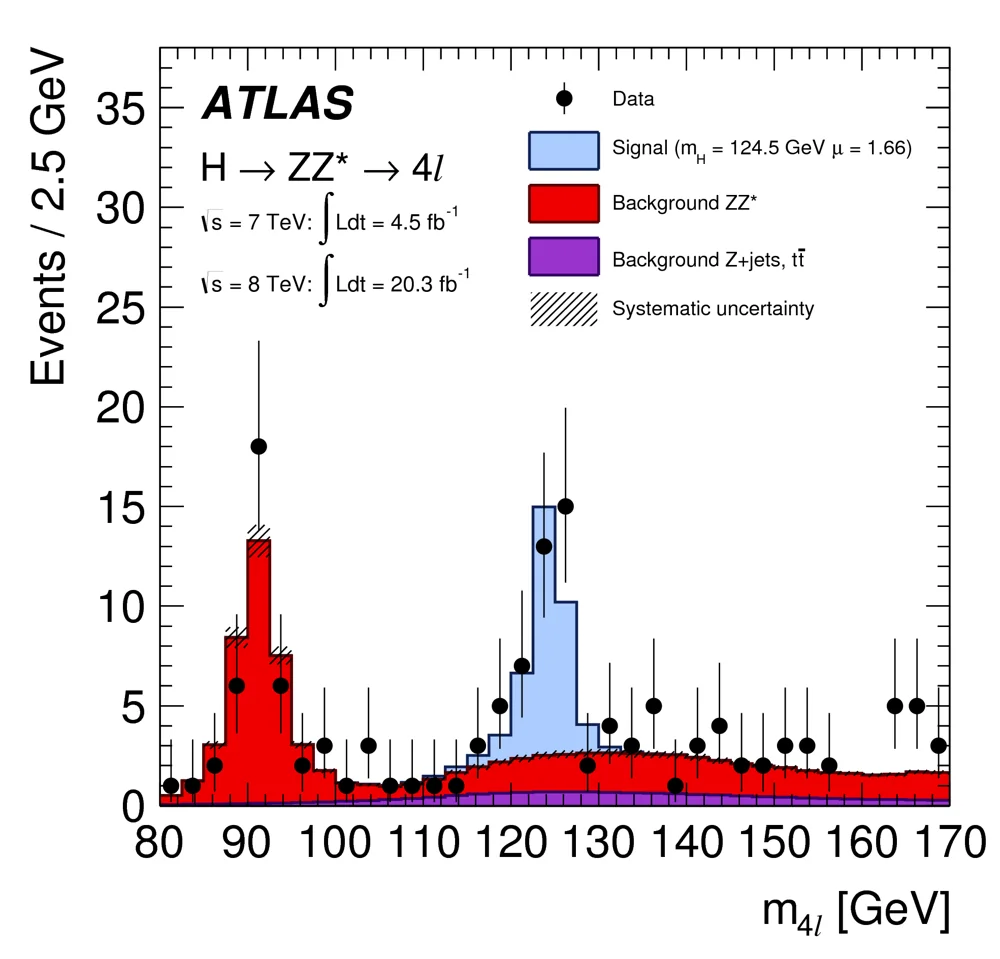
Measurement of the Higgs boson mass from the \(H\to\gamma\gamma\) and \(H\to ZZ^{*}\to 4\ell\) channels with the ATLAS detector using 25 fb\(^{−1}\) of pp collision data
Phys. Rev. D. 90 (2014) 052004
What I did
Using methods I developed to validate the alignment of the detector and the calibration of muons within ATLAS we were able to effectively eliminate systematic biases in the measured muon kinematics.
Abstract
An improved measurement of the mass of the Higgs boson is derived from a combined fit to the invariant mass spectra of the decay channels \(H\to\gamma\gamma\) and \(H\to ZZ^{*}\to 4\ell\). The analysis uses the pp collision data sample recorded by the ATLAS experiment at the CERN Large Hadron Collider at center-of-mass energies of 7 TeV and 8 TeV, corresponding to an integrated luminosity of 25 fb\(^{−1}\). The measured value of the Higgs boson mass is \(m_{H}\) = 125.36 ± 0.37 (stat) ± 0.18 (syst) GeV. This result is based on improved energy-scale calibrations for photons, electrons, and muons as well as other analysis improvements, and supersedes the previous result from ATLAS. Upper limits on the total width of the Higgs boson are derived from fits to the invariant mass spectra of the (H\to\gamma\gamma\) and \(H\to ZZ^{*}\to 4\ell\) decay channels.
Study of the material of the ATLAS inner detector for Run 2 of the LHC
What I did
I developed a method to accurately measaure the material in the ATLAS inner detector. The method was used to study the material of the pixel detector and the strip tracker in the forward rapidity region.
Abstract
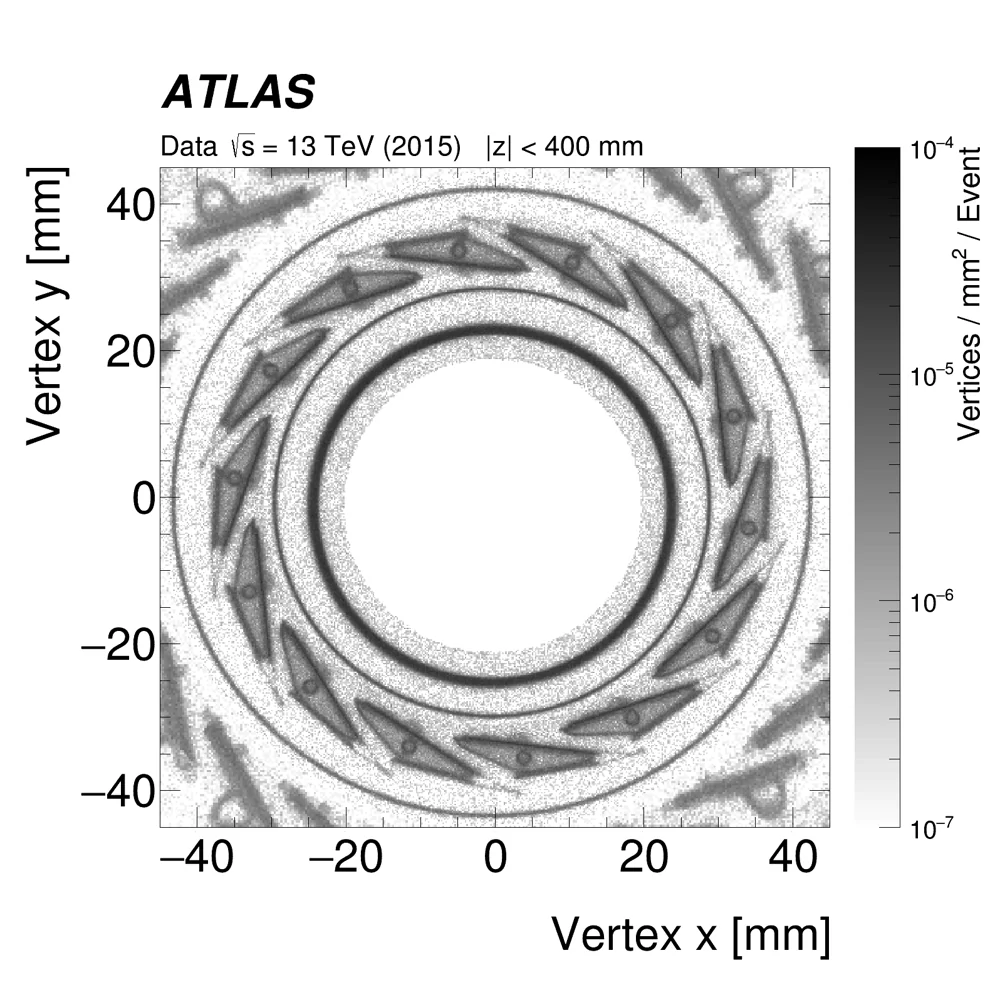
The ATLAS inner detector comprises three different sub-detectors: the pixel detector, the silicon strip tracker, and the transition-radiation drift-tube tracker. The Insertable B-Layer, a new innermost pixel layer, was installed during the shutdown period in 2014, together with modifications to the layout of the cables and support structures of the existing pixel detector. The material in the inner detector is studied with several methods, using a low-luminosity \(\sqrt{s} \)=13 TeV pp collision sample corresponding to around 2.0 nb\(^{−1}\) collected in 2015 with the ATLAS experiment at the LHC. In this paper, the material within the innermost barrel region is studied using reconstructed hadronic interaction and photon conversion vertices. For the forward rapidity region, the material is probed by a measurement of the efficiency with which single tracks reconstructed from pixel detector hits alone can be extended with hits on the track in the strip layers. The results of these studies have been taken into account in an improved description of the material in the ATLAS inner detector simulation, resulting in a reduction in the uncertainties associated with the charged-particle reconstruction efficiency determined from simulation.
Observation of a new particle in the search for the Standard Model Higgs boson with the ATLAS detector at the LHC
What I did
The improved electron reconstruction and identification that I developed for this measurement led to 30% improvement in the sensitivity of the \(H \to ZZ^{(*)} \to eeee\) channel.
Abstract
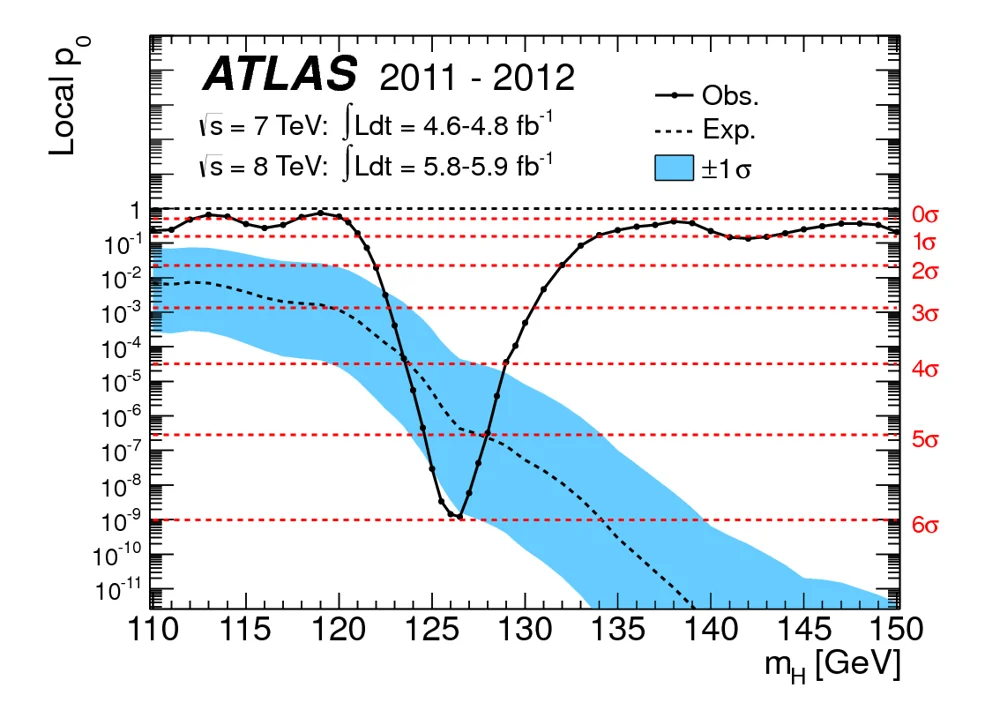
A search for the Standard Model Higgs boson in proton-proton collisions with the ATLAS detector at the LHC is presented. The datasets used correspond to integrated luminosities of approximately 4.8 fb\(^{-1}\) collected at \(\sqrt{s}\) = 7 TeV in 2011 and 5.8 fb\(^{-1}\) at \(\sqrt{s}\) = 8 TeV in 2012. Individual searches in the channels \(H \to ZZ^{(*)} \to \ell\ell\ell\ell\), \(H\to\gamma\gamma\) and \(H\to WW\to e\nu\mu\nu\) in the 8 TeV data are combined with previously published results of searches for \(H \to ZZ^{(*)}\), \(WW^{(*)}\), \(b\bar{b}\) and \(\tau^{+}\tau^{-}\) in the 7 TeV data and results from improved analyses of the \(H \to ZZ^{(*)} \to \ell\ell\ell\ell\) and \(H\to\gamma\gamma\) channels in the 7 TeV data. Clear evidence for the production of a neutral boson with a measured mass of 126.0 ± 0.4(stat) ± 0.4(sys) GeV is presented. This observation, which has a significance of 5.9 standard deviations, corresponding to a background fluctuation probability of 1.7x10\(^{-9}\), is compatible with the production and decay of the Standard Model Higgs boson.
Search for the Standard Model Higgs boson in the decay channel H->ZZ(*)->4l with 4.8 fb-1 of pp collision data at sqrt(s) = 7 TeV with ATLAS
Phys. Lett. B 710 (2012) 383-402
What I did
I developed a method to accurately measaure the material in the ATLAS inner detector. The method was used to study the material of the pixel detector and the strip tracker in the forward rapidity region.
Abstract
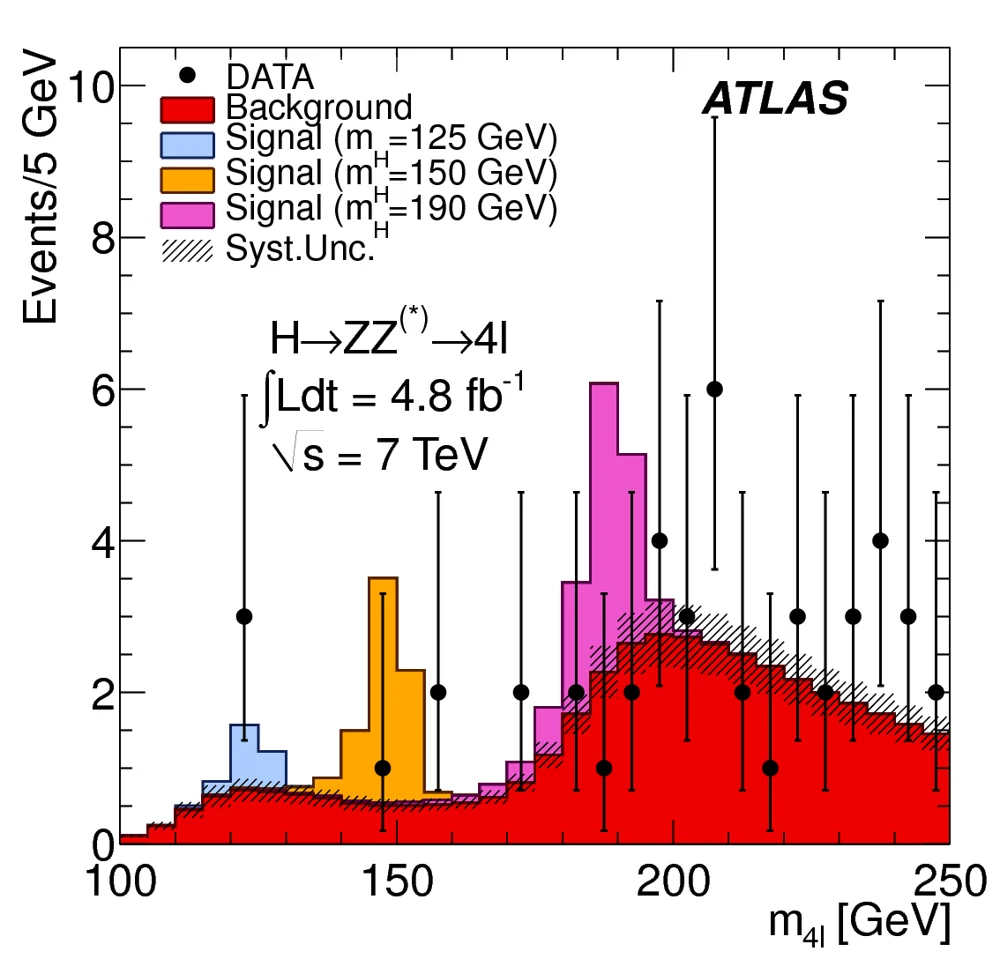
This Letter presents a search for the Standard Model Higgs boson in the decay channel H->ZZ(*)->l+l-l'+l'-, where l,l'=e or mu, using proton-proton collisions at sqrt(s) = 7 TeV recorded with the ATLAS detector and corresponding to an integrated luminosity of 4.8 fb^-1. The four-lepton mass distribution is compared with Standard Model background expectations to derive upper limits on the cross section of a Standard Model Higgs boson with a mass between 110 GeV and 600 GeV. The mass ranges 134-156 GeV, 182-233 GeV, 256-265 GeV and 268-415 GeV are excluded at the 95% confidence level. The largest upward deviations from the background-only hypothesis are observed for Higgs boson masses of 125, 244 and 500 GeV with local significances of 2.1, 2.2 and 2.1 standard deviations, respectively. Once the look-elsewhere effect is considered, none of these excesses are significant.
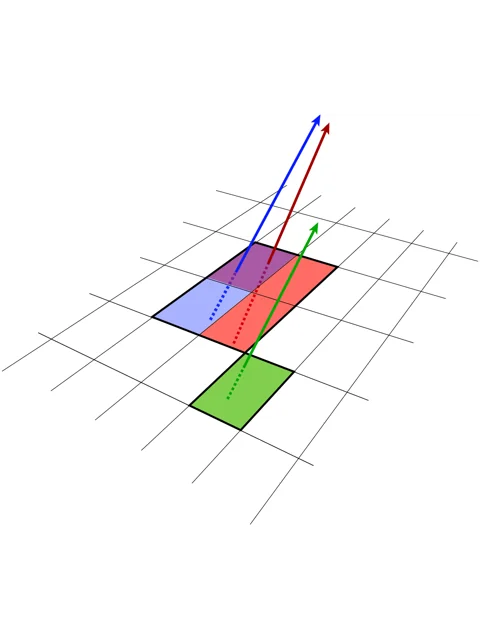
Performance of the ATLAS Track Reconstruction Algorithms in Dense Environments in LHC Run 2
What I did
Lead designer of the improvements to the track reconstruction algorithm which both improved CPU and Physics performance of the track reconstruction. Utilized neural networks to identify detector measurements created by collimated particles.
Abstract
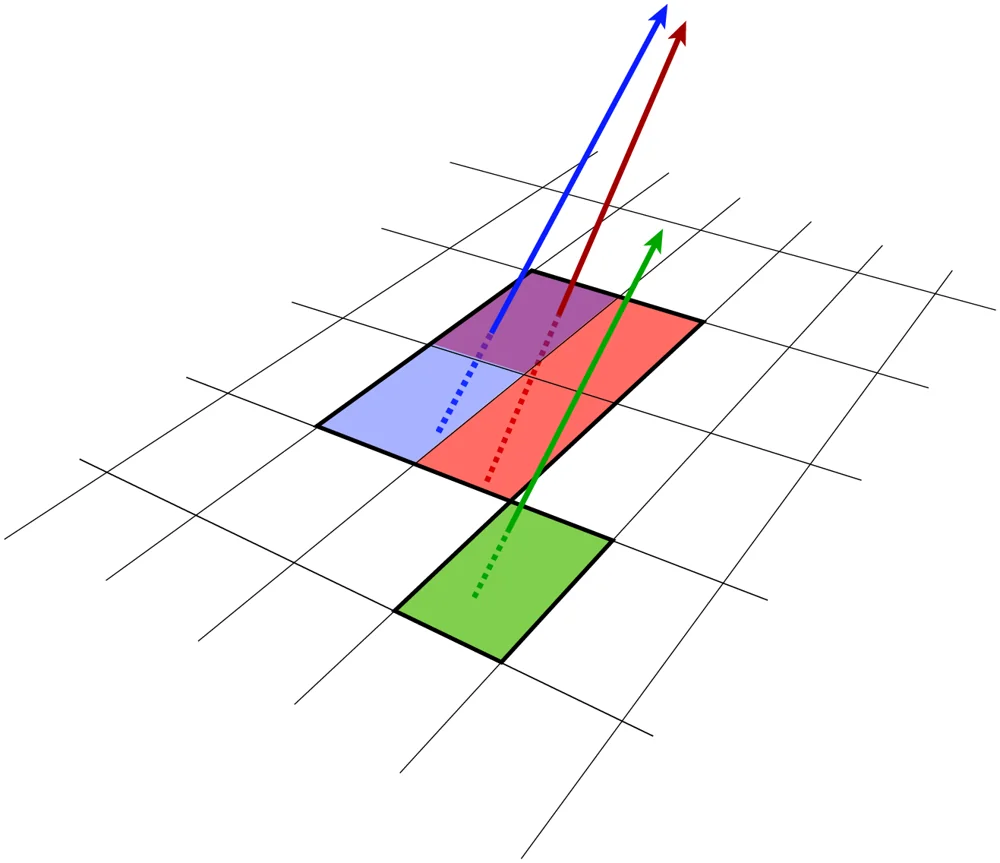
With the increase in energy of the Large Hadron Collider to a centre-of-mass energy of 13 TeV for Run 2, events with dense environments, such as in the cores of high-energy jets, became a focus for new physics searches as well as measurements of the Standard Model. These environments are characterized by charged-particle separations of the order of the tracking detectors sensor granularity. Basic track quantities are compared between 3.2 fb\(^{−1}\) of data collected by the ATLAS experiment and simulation of proton-proton collisions producing high-transverse-momentum jets at a centre-of-mass energy of 13 TeV. The impact of charged-particle separations and multiplicities on the track reconstruction performance is discussed. The efficiency in the cores of jets with transverse momenta between 200 GeV and 1600 GeV is quantified using a novel, data-driven, method. The method uses the energy loss, dE/dx, to identify pixel clusters originating from two charged particles. Of the charged particles creating these clusters, the measured fraction that fail to be reconstructed is 0.061±0.006(stat.)±0.014(syst.) and 0.093±0.017(stat.)±0.021(syst.) for jet transverse momenta of 200-400 GeV and 1400-1600 GeV, respectively.
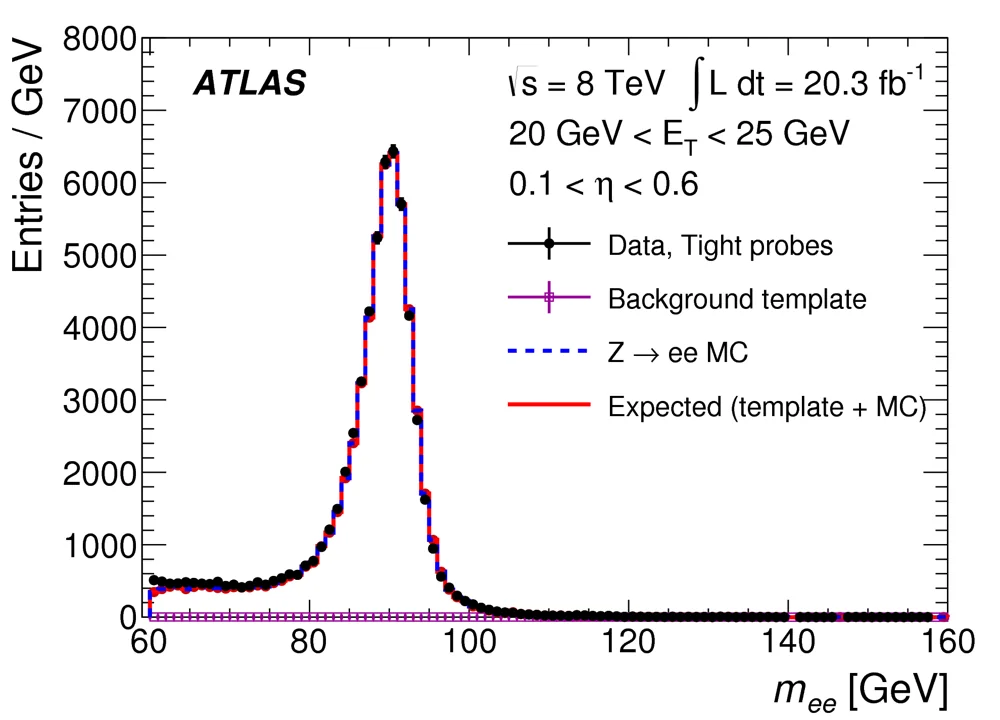
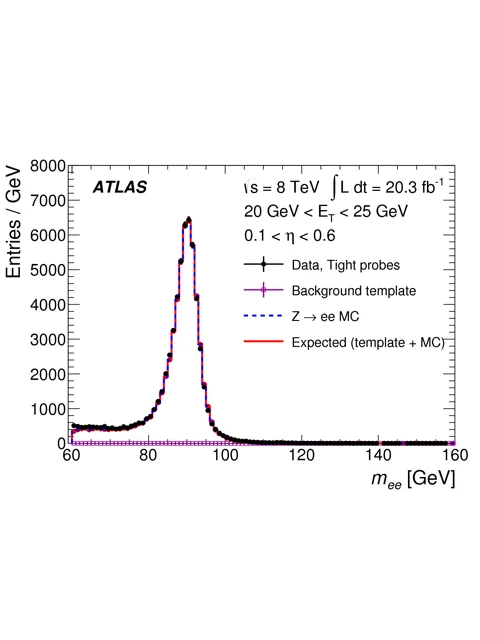
Electron reconstruction and identification efficiency measurements with the ATLAS detector using the 2012 LHC proton--proton collision data
What I did
Performed a number of studies into the electron reconstruction performance to understand the difference observed between data and simulation.
Abstract
This paper describes the algorithms for the reconstruction and identification of electrons in the central region of the ATLAS detector at the Large Hadron Collider (LHC). These algorithms were used for all ATLAS results with electrons in the final state that are based on the 2012 pp collision data produced by the LHC at s√ = 8 TeV. The efficiency of these algorithms, together with the charge misidentification rate, is measured in data and evaluated in simulated samples using electrons from Z→ee, Z→eeγ and J/ψ→ee decays. For these efficiency measurements, the full recorded data set, corresponding to an integrated luminosity of 20.3 fb\(^{−1}\), is used. Based on a new reconstruction algorithm used in 2012, the electron reconstruction efficiency is 97% for electrons with \(E_{T}\)=15 GeV and 99% at \(E_{T}\)=50 GeV. Combining this with the efficiency of additional selection criteria to reject electrons from background processes or misidentified hadrons, the efficiency to reconstruct and identify electrons at the ATLAS experiment varies from 65% to 95%, depending on the transverse momentum of the electron and background rejection.
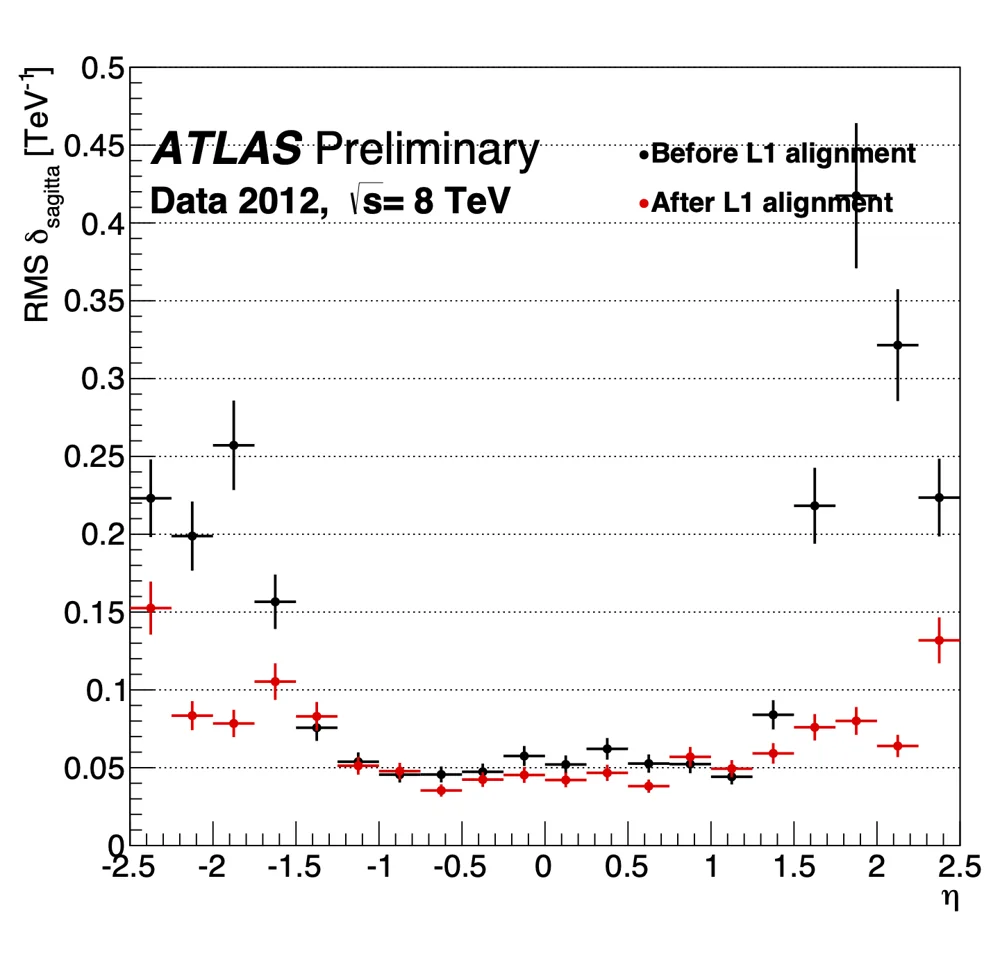
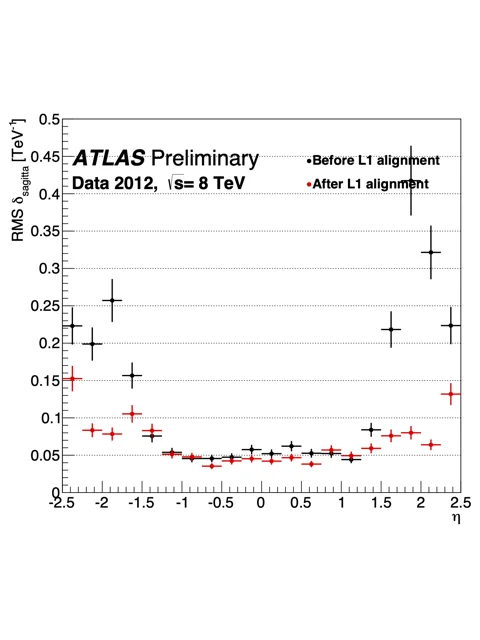
Alignment of the ATLAS Inner Detector and its Performance in 2012,
What I did
Lead editor and analyst. Detailed the methods and results of the Inner detector alignment. The results in this note were later vital in the measurement of the forward backward symmetry of Z boson and the method described were used for verifying the calibration the W mass measurement and Higgs mass measurement.
Abstract
The alignment of the ATLAS Inner Detector tracking system has been tuned using advanced procedures for the analysis of the LHC sqrt{s}=8 TeV proton-proton collision data taken during 2012. The description of the detector geometry takes care of the relative alignment of the sensing devices and the magnetic field, momentum biases due to systematic deformations, misalignments affecting the reconstructed track parameters and time-dependent displacements occurring due to environmental changes. The procedures applied as well as the performance of the resulting alignment are presented.